



Here on The Howe we always aim to manage the land with nature in mind.
In keeping with this ethos, our Allotment Association Committee has recently decided to issue guidelines on the use of weedkillers. These aim to encourage all plot holders to think carefully about more nature-friendly options to prevent or tackle weeds on their allotments (and gardens) before reaching for the weedkiller bottle.
But why is this important?
There are 3 main reasons why we should all reduce the use of weedkillers:
- Minimize potential risks to human and other animal health
- To protect the local environment
- Safeguard beneficial wildlife, insects including pollinators, aquatic life and soil microorganisms
What are the Health Risks of Using Weedkillers?
The health risks are many. The International Agency for Research on Cancer (IARC), which is part of the World Health Organisation, classifies glyphosate as “probably carcinogenic to humans” based on limited human data and animal tests. Further health issues cited are that the chemical can cause kidney and liver damage, imbalances in the intestines, endocrine disruption, neurological damage, infertility, pregnancy problems, birth defects, respiratory diseases and immune system dysfunction.
How do Weedkillers Damage Nature?
Glyphosate also has direct and indirect effects on the environment. Studies show that widely used weedkillers like glyphosate can negatively affect pollinators such as honeybees by altering their brain chemistry and reducing their foraging activity by 13%. Indirect impacts on birds and other animals occur due to the wiping out of weeds and wildflowers, destroying habitats and food supplies. A less well known fact is that Glyphosate has also been found to have adverse effects on earthworms and other beneficial insects that live in our soil. Weedkillers negatively affects our soil’s fungal biomass, beneficial microorganisms, and the overall microbial diversity in the soil. Not a great result for gardeners!
Chemical sprays can also cause damage to non-target plants – when drift or spread, kills nearby desirable flowers, fruit, vegetables, and native plants. Growing media can become contaminated by weedkillers, and Clopyralid, an active ingredient in many selective lawn weedkillers, binds to grass and remains active in grass clippings meaning that adding these to an allotment compost bin, results in producing compost that can damage and distort allotment grown plants.
Weedkillers can sadly also pollute our water networks when residues wash into soil, groundwater, and nearby streams, damaging important aquatic ecosystems – and potentially us when the contaminated water finds its way into our taps!
Responsible Use of Weedkillers
Clearly using such toxic weedkillers should be recognised as a large responsibility and they must always be kept away from children and pets. Appropriate PPE must be worn when handling it. It’s also the responsibility of the user to always check the active ingredients list and warning labels on your specific bottle to ensure you are treating the correct weeds without accidentally harming your soil or nearby landscape.
How to Control Weeds Naturally
The National Allotment Society state that weeds are part of allotment life, but that they can be managed with regular attention. Likewise, the RHS no longer approve the use of chemical weedkillers, and instead state that with some patience and persistence, all garden weeds (with the exception of Japanese knotweed) can be controlled using non-chemical methods.
The 3 main actions they recommend are:
- Mulching beds to create a barrier and smother and so reduce weed growth (and retain moisture). Late winter/early spring is a good time to install preventative measures.
- Hand-weed little and often. Spring and summer are the main seasons for regular weeding.
- Hoe through the growing season to stay on top of regrowth – repeated cutting weakens even the most vigorous weeds (like Marestail).
Remember non-chemical methods aren’t just planet-friendly, they are safer to use around the produce you and your family are going to eat!
Types of Weedkillers
Not all weedkillers are the same. If you must use a weedkiller then it is much better to use one that does NOT include Glyphosate. While Glyphosate is still available for sale in garden centres in the UK it should be recognised as a very toxic, last resort chemical substance. In fact, several EU countries—including France, the Netherlands, and Belgium—prohibit glyphosate use for private home gardeners and household consumers. While some nations like Germany restrict or ban its use in public parks, playgrounds, and municipal green spaces.
Homemade Weed Control
Some councils are trialling vinegar (acetic acid) as a long-term solution to removing weeds in towns and cities. It doesn’t work well on its own, so it needs to be mixed with baking soda, salt or lemon juice.
Baking soda and vinegar weed killer recipe:
- One part baking soda
- Two parts white vinegar
- Lemon juice (optional)
Best for: Young or annual weeds, in paved areas
Natural/Organic Bought Contact Sprays
These are so-called ‘bio-herbicides’ and work by burning back small, young annual weeds on the surface. They do not kill the roots or leave long-term soil residues but will damage any vegetable leaves they touch, so ensure very targeted spraying or crops will be killed/damaged (spray drift).
- Neudorff’s WeedFree Plus is a pelargonic acid weed killer that is safe for use around pets and wildlife when dry and safe around edible crops but prevent spray drift. Can see results in 1 day and safe to replant after 2 days.
- Weedol Rapid: contains pelargonic acid. Fast-acting, visible results in 2 to 3 hours, safe to replant after 3 days; Total contact weedkiller and will destroy any green plant tissue it hits- prevent spray drift.
- Vitax SBK Brushwood Killer is a non-organic selective, glyphosate-free herbicide that kills tough weeds, woody growth, and tree stumps down to the root without harming established grass. Its active ingredient is triclopyr, and it is safe for home gardeners when used properly. Environmental Impact: It is strictly regulated and should not be used near ponds, waterways, or unmanaged aquatic environments.
Roundup Total Optima: (see below) Uses pelargonic acid, works in 3 hours, and kills weeds in under 24 hours.
NOTE Not all Roundup branded products are the same. Roundup Total Optima and Path Optima are glyphosate-free (using pelargonic acid instead), whereas older or differently named formulations like Roundup Optima+ do contain glyphosate) – so it’s very important to check labels and ingredients carefully.
Popular Glyphosate-Free Alternatives – for hard surfaces
- Resolva Path & Drive: Naturally based acetic acid formula for hard surfaces.
- Hytrol Natural Weedkiller: Biodegradable, fast-acting formula for paths and patios.
We hope you have found this blog informative.
Have you got any environmentally useful tips on tackling weeds that you’d like to pass on? If so we’d love to hear from you!
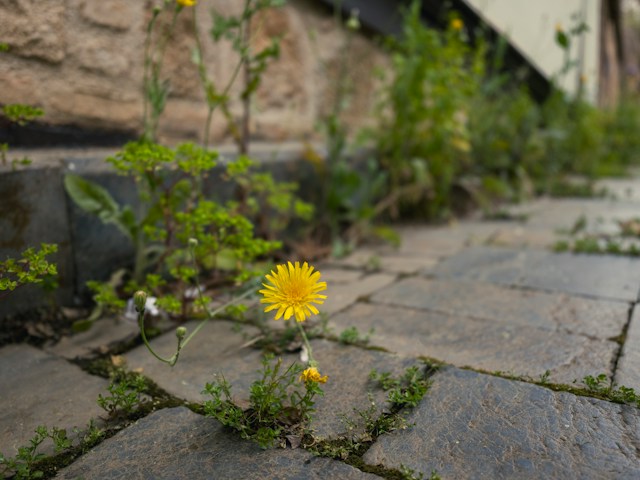
Photo from Unsplash by enginakyurt
Leave a Reply